Tell us about the job
Takes about a minute. No obligation.
Electricity heats more occupied homes in Marlboro County, South Carolina than any other fuel, at 74.9% (2020-2024 ACS 5-year). Electric resistance water heaters put their entire load on the heating elements and thermostats directly, with no burner, no flue, and no combustion air to diffuse wear across. In a county where nearly all occupied homes run on electricity, contractors repairing water heaters here see element burnout and thermostat failure far more than venting or combustion faults. Sediment buildup accelerates element failure by forcing the element to run hotter to push heat through the deposit layer, so a contractor opening a unit here checks element condition and the anode rod before quoting any other repair.
Sediment buildup, corroded anode rods, and resealed connections from previous repairs are what a contractor finds once the unit is open in a house with this kind of history. Half the homes in Marlboro County, South Carolina were built in 1977 or earlier (2020-2024 ACS 5-year). That depth of accumulated work changes the repair scope: a straightforward element swap can become a full internal inspection once the panels come off and earlier patchwork is visible. Parts availability matters here too, because systems that have cycled through multiple replacements over decades do not always share the same fittings or connection types.
The Parts of a Water Heater a Contractor Checks During a Repair
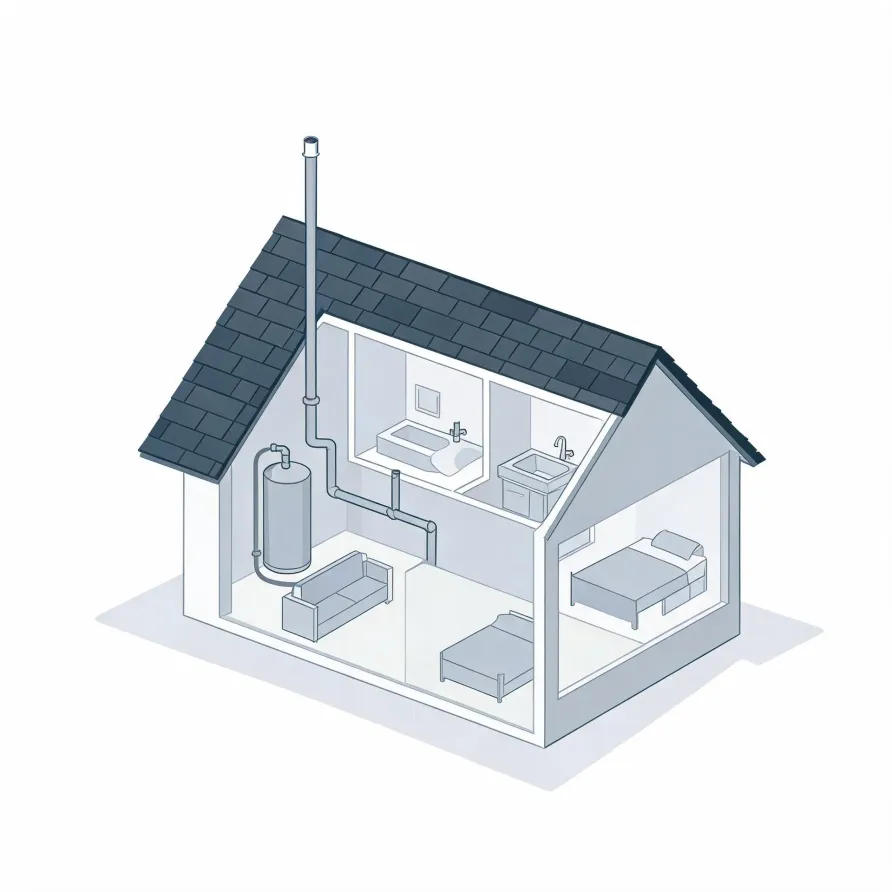
The tank is what most homeowners picture first: a large insulated cylinder that sits in a utility room, basement, or garage and holds the supply of hot water for the house. Attached to it are the heating elements or burner assembly, which do the actual work of raising the water temperature, and the thermostat, which tells those components when to run. When hot water runs out fast, arrives lukewarm, or does not arrive at all, those are the pieces a contractor looks at first.
The pressure relief valve mounts directly on the tank and opens automatically if pressure inside climbs too high. The anode rod hangs inside the tank and slows corrosion of the tank walls. Inlet and outlet pipes connect the unit to the home's cold supply and hot distribution lines, and the drain valve at the base of the tank lets a contractor flush sediment that settles over time.
The drawing shows a general layout of these components, and a licensed contractor determines exactly what applies to the unit in your home.
Get matched in Marlboro CountyMarlboro County, by the numbers
83 severe weather events were recorded in Marlboro County, South Carolina between 2015 and 2024.
NOAA National Centers for Environmental Information, Storm Events Database, bulk CSV export, events 2015-01-01 through 2024-12-31.Half the homes in Marlboro County, South Carolina were built in 1977 or earlier (2020-2024 ACS 5-year).
U.S. Census Bureau, 2020-2024 American Community Survey 5-Year EstimatesMarlboro County, South Carolina holds 12,077 housing units (2020-2024 ACS 5-year).
U.S. Census Bureau, 2020-2024 American Community Survey 5-Year EstimatesOwners occupy 63.0% of the occupied homes in Marlboro County, South Carolina (2020-2024 ACS 5-year).
U.S. Census Bureau, 2020-2024 American Community Survey 5-Year EstimatesCodes & Standards Governing Water Heater Repair in Marlboro County, South Carolina1 sourced rules and standards
Licensing Rules for HVAC Repair in Marlboro County, South Carolina
South Carolina requires a mechanical contractor license for contracting work whose total cost of construction is greater than ten thousand dollars.
Severe Weather Events in Marlboro County
Storm activity puts water heaters under stress. Pressure swings, power disruptions, and flooding conditions all push equipment harder, and how much of that a unit has absorbed is a local question a Marlboro County contractor can read from the history.
83 severe weather events, 2015–2024. Source: NOAA National Centers for Environmental Information, Storm Events Database.